The flight folder
Dated route cards, from Bahrain to New York
The Concorde made its first transatlantic crossing on 26 September 1973.1
National Museums Scotland describes that first non-stop Atlantic crossing as a French aircraft flying from Washington to Orly, Paris, in three hours and 33 minutes, at an average speed of 954 mph.2
Scheduled passenger service did not begin with New York. It began, on the same day, with two different airlines and two different oceans.
-
21 January 1976
London — Bahrain
British Airways’ first commercial flight was London Heathrow to Bahrain, BA300, on 21 January 1976, with Captain Norman Todd.3
National Museums Scotland says commercial flights began on 21 January 1976, with Alpha Alpha flying from London to Bahrain and an Air France Concorde flying from Paris to Rio.2
-
21 January 1976
Paris — Rio de Janeiro
Scheduled supersonic passenger service began on 21 January 1976: British Airways initially flying from London to Bahrain, and Air France from Paris to Rio de Janeiro.1
-
May 1976 · November 1977
Washington, then New York
Both airlines added regular service to Washington, D.C., in May 1976, and to New York City in November 1977.1
-
The later years
New York, the last regular destination
Noise and operating expense limited the service. Financial losses led both airlines to cut routes, eventually leaving New York City as their only regular destination.1
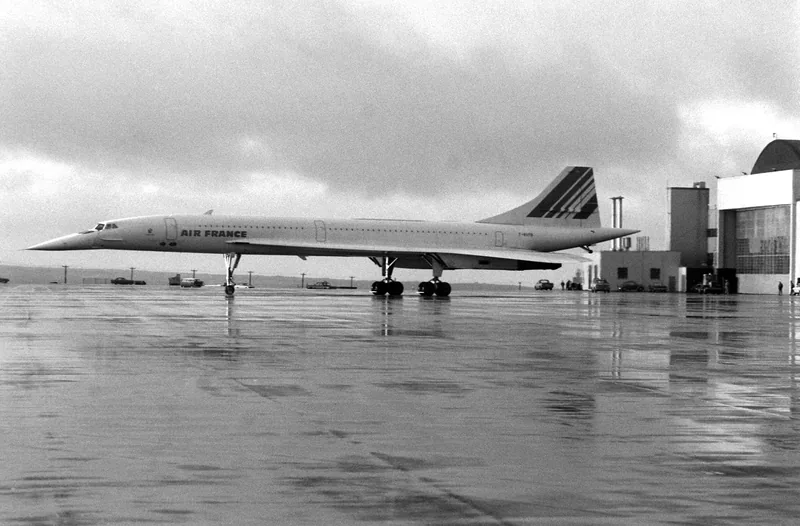
In November 1986 a British Airways Concorde flew around the world, covering 28,238 miles in 29 hours, 59 minutes.3
In 2003, National Museums Scotland records, the standard return fare from London to New York was £6,636.2
British Airways Concorde made just under 50,000 flights and flew more than 2.5 million passengers supersonically.3
National Museums Scotland says more than 2.5 million passengers have flown supersonically on Concorde since 1976, and that each passenger was issued with a certificate to prove they had broken the sound barrier.2
Between 1976 and 2003, National Museums Scotland says, British Airways’ Concorde planes operated close to 50,000 flights, clocked up more than 140,000 flying hours, and travelled 140 million miles.2
Just under 50,000 flights
British Airways says it made just under 50,000 flights and flew more than 2.5 million passengers. National Museums Scotland, writing about British Airways’ Concorde operations between 1976 and 2003, says close to 50,000 flights, more than 140,000 flying hours and 140 million miles, and, separately, that more than 2.5 million passengers have flown supersonically on Concorde since 1976. The numbers sit close together; the wording is not identical.
The clock that puts a typical crossing next to a subsonic one is on the crossing page.