Concorde, the crossing that took a little less than three and a half hours
The Anglo-French supersonic airliner that shrank the Atlantic, heated and stretched in the cruise, and left fourteen aircraft in service — and a handful of carefully worded times still worth comparing.
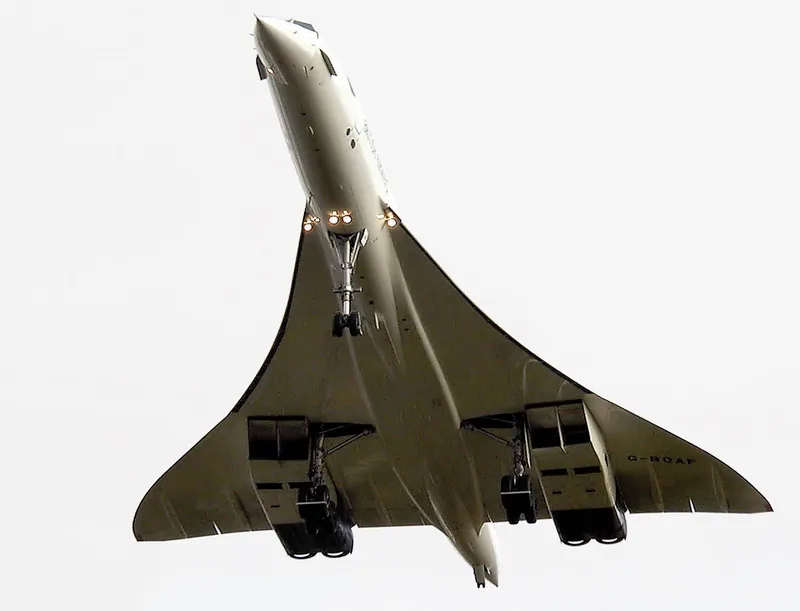
G-BOAF over the A38 on the last ever Concorde landing, Filton, 26 November 2003.Photo: Adrian Pingstone · Public domain · Commons
The crossing clock
London to New York, side by side
British Airways says a typical London to New York crossing would take a little less than three and a half hours, as opposed to about eight hours for a subsonic flight.1
Concorde’s fastest transatlantic crossing, according to British Airways, was on 7 February 1996, when it completed the New York to London flight in 2 hours 52 minutes and 59 seconds.1
About three hours, or a little less than three and a half?
Encyclopaedia Britannica says the maximum cruising speed allowed the flight time between London and New York to be reduced to about three hours. British Airways, describing a typical crossing, says “a little less than three and a half hours, as opposed to about eight hours for a subsonic flight.” Both figures are kept in view: one is a speed claim turned into a duration, the other is the airline’s wording for a typical service.
Concorde
T+ 00:00
03:30 typical (BA: a little less than 3½ hours)
A subsonic flight
T+ 00:00
08:00 typical (BA: about eight hours)
The clocks are sped up so a three-and-a-half-hour crossing takes 21 seconds on this page, and an eight-hour subsonic flight takes 48 seconds. If you prefer reduced motion, the desks jump to “arrived”. The numbers themselves are British Airways’ wording, not a simulation of weather or routing.
The same comparison, without the animation
Aircraft
Typical London–New York time (BA)
Concorde
A little less than three and a half hours
A subsonic flight
About eight hours
Fastest recorded (BA)
New York to London, 7 February 1996: 2 hours 52 minutes and 59 seconds
A flight folder, not a straight timeline
Scheduled service opened on two different oceans on the same day. The cards below are set out like timetable leaves — date, route, airline — rather than as a single narrative.
21 January 1976
London — Bahrain
British Airways’ first commercial flight was London Heathrow to Bahrain, BA300, on 21 January 1976, with Captain Norman Todd.1
National Museums Scotland says commercial flights began on 21 January 1976, with Alpha Alpha flying from London to Bahrain and an Air France Concorde flying from Paris to Rio.2
21 January 1976
Paris — Rio de Janeiro
Scheduled supersonic passenger service began on 21 January 1976: British Airways initially flying from London to Bahrain, and Air France from Paris to Rio de Janeiro.3
May 1976 · November 1977
Washington, then New York
Both airlines added regular service to Washington, D.C., in May 1976, and to New York City in November 1977.3
The later years
New York, the last regular destination
Noise and operating expense limited the service. Financial losses led both airlines to cut routes, eventually leaving New York City as their only regular destination.3
Concorde measured nearly 204 ft in length and stretched between 6 and 10 inches in flight due to heating of the airframe. It was painted in a specially developed white paint to accommodate these changes and to dissipate the heat generated by supersonic flight.1
British Airways gives a take-off speed of 220 knots (250 mph) and a cruising speed of 1,350 mph — more than twice the speed of sound — up to 60,000 ft.1
British Airways says the airframe stretched between 6 and 10 inches in flight because of heating, and was painted in a specially developed white paint.Drawing: our own, simplified and not to scale
A reference guide, a short transatlantic companion, and an activity pack. Prices are in US dollars.
The Concorde Reference Guide
A fact-checked 11-page guide to the Anglo-French supersonic airliner: how it was built, how it flew, the transatlantic run, and what happened when the service ended. A4 and US Letter.
A 7-page quiz, myth-or-fact cards and a crossing-time worksheet with answers, following the sourced wording used on concorde.aeroplanes.im. A4 and US Letter.